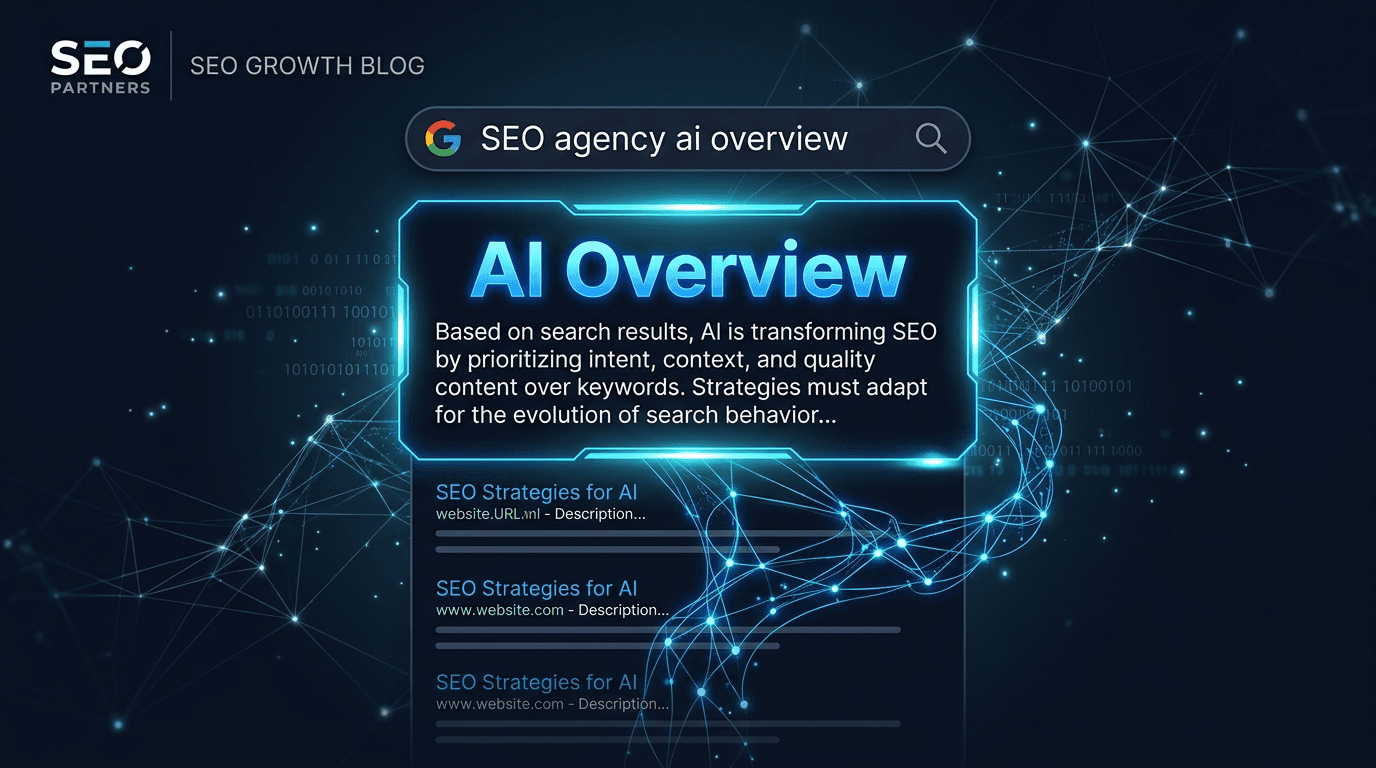
Search changed in 2024. Most businesses haven't caught up yet.
Google rolled out AI Overviews at scale: the synthesised, AI-generated answer that now appears above the traditional blue links on a growing percentage of searches. ChatGPT added web search. Perplexity became a genuine research tool for professionals. And Gemini, Claude, and a dozen other AI systems are crawling the web and generating answers in response to user queries.
If you're featured in those answers, you get the visibility, the authority, and often the click. If you're not, your competitor does.
Generative Engine Optimisation: GEO: is the practice of making sure AI engines choose you.
What GEO Actually Means
The term is new. The underlying signals aren't entirely.
GEO is the set of technical, content, and authority practices that increase the probability of your website being cited as a source in AI-generated answers. It sits alongside traditional SEO: not replacing it, but extending it to cover a new set of search surfaces.
To understand why it matters, you need to understand how AI search works at a basic level.
When you ask Google a question and an AI Overview appears, Google has:
- Run the query through its language model
- Retrieved candidate web pages (using its existing search index)
- Synthesised the content of those pages into a generated answer
- Selected the sources it considers most credible to cite
Step 4 is where GEO operates. Which pages does the AI consider credible enough to cite? Which content is structured clearly enough to extract from? Which authors and organisations does the AI trust?
These are answerable questions. And the answers determine whether you're in the overview or invisible beneath it.
How GEO Differs from Traditional SEO
Traditional SEO gets you ranked in a list of ten links. The user sees your title tag and meta description, decides whether to click, and arrives at your page. You control the first impression.
GEO gets you cited inside the answer itself. The AI synthesises the key information from your page and presents it as the answer: often without the user needing to click at all. Your page becomes the source; the AI becomes the interface.
This has two implications that matter commercially.
First, citation without a click still builds brand authority. If Google's AI Overview for "who are the best SEO agencies in Southport" cites Churchtown Media, that's a trust signal: even if the user doesn't click through immediately. The next time they encounter the name, they recognise it.
Second, traffic patterns are shifting. AI Overviews on informational queries often reduce clicks: people get the answer they needed and don't proceed. But on commercial queries ("which SEO agency should I hire", "what's the best service for X"), citation drives high-intent traffic. That's where GEO investment pays off.
The GEO Signal Framework
There are four categories of signals that influence whether AI engines cite you.
1. E-E-A-T Signals
Experience, Expertise, Authoritativeness, Trustworthiness. Google's own quality rater guidelines describe these as the core quality signals for content. AI engines trained on Google's quality assessments use them too.
In practice, E-E-A-T means:
- Named authors with verifiable credentials and professional profiles
- Content that demonstrates first-hand experience (case studies, specific data, field knowledge)
- An organisation with a clear identity, address, and professional presence
- External references and citations from credible sources
Generic AI content written by "the team" and published without attribution is the opposite of E-E-A-T. This is why human expertise and named authorship matter more in 2026 than they did in 2020.
2. Structured Data
AI engines read structured data the same way traditional search engines do: preferentially. A page with a properly implemented FAQPage schema is easier for an AI to extract an answer from than a page that buries its FAQ in unstructured prose.
The schemas that matter most for GEO:
- FAQPage: direct question-and-answer format that AI engines parse cleanly
- HowTo: step-by-step instructions, easily synthesised
- Article and BlogPosting: with proper author attribution
- Organization: entity recognition for your brand
- Service: for commercial pages, with pricing and offers
3. Content Structure and Clarity
AI models extract information from web pages during retrieval. Pages with clear headings, short declarative paragraphs, and specific factual claims are more extractable than long paragraphs of flowing prose.
This doesn't mean dumbing content down. It means structuring information so the key points are findable. A page that opens with "The postcode for Formby Beach is L37 1YH" answers the query on the first line. A page that answers it in paragraph four: after an introduction about the history of the beach: doesn't.
4. Off-Site Authority and Entity Recognition
AI engines don't just read your website. They build a model of your entity: your business, your people, your content: across the entire web. Wikipedia pages, industry directories, press mentions, LinkedIn profiles, Companies House records, and external backlinks all contribute to how the AI understands and trusts your entity.
Businesses with strong off-site entity signals are more likely to be cited as authoritative sources. This is why digital PR: getting your business mentioned in credible external publications: is a GEO signal, not just a traditional SEO signal.
AI Crawler Access: The Technical Foundation
Before any of the above matters, AI crawlers need to be able to access your site.
Most AI engines operate their own crawlers:
- GPTBot: OpenAI (ChatGPT)
- ClaudeBot: Anthropic
- PerplexityBot: Perplexity
- GoogleOther: Google AI systems
- Applebot: Apple intelligence features
Many websites block these crawlers accidentally: either through robots.txt rules that are too broad, or security configurations that block unrecognised user agents. If an AI crawler can't access your site, it can't cite you. That's the baseline technical requirement for GEO.
A GEO audit always starts by verifying that each major AI crawler has clean access to your pages.
The Case for Acting Now
In March 2026, most businesses have not started thinking about GEO. Most marketing teams are still focused on traditional organic rankings and paid search. Most agencies don't offer GEO as a distinct service.
That is an opportunity window. The businesses that establish AI citation authority now: through E-E-A-T content, structured data, and entity building: will be significantly harder to displace once the market catches up.
This is how the early moves in SEO played out twenty years ago. The businesses that understood PageRank and built authority early held competitive advantages that took years to erode. GEO is following the same pattern.
We helped Alotek Shelters achieve #1 AI Overview appearances across their core commercial terms within 30 days. That result was possible because their sector is not yet contested at the GEO level. That window will close.
What GEO Work Actually Looks Like
A GEO engagement starts with an audit: where does the AI currently cite your competitors? Which queries trigger AI Overviews in your sector? Which content types and structures are being selected?
From there, the work is concrete:
- Technical: verify AI crawler access, implement structured data across the site, fix any crawlability issues
- Content: produce E-E-A-T-compliant content targeting the specific queries that trigger AI answers
- Authority: build off-site citations and entity signals through digital PR and directory presence
- Monitoring: track AI Overview appearances and Perplexity/ChatGPT citations monthly
It's not a single project. It's an ongoing discipline: because AI search is evolving and the signals that work today will be refined over time.
Where to Start
If you want to understand your current position before committing to anything, the right first step is a GEO audit. It maps your existing AI citation status, identifies which competitors are currently cited in your sector, and tells you what the gap looks like technically and in terms of content.
From that baseline, you can decide whether to execute the changes yourself, commission the work from us, or both.
The one thing I'd caution against is waiting until GEO is mainstream. By then, the early-mover advantage is gone.
Related reading: AI SEO vs Traditional SEO: What's Actually Changed?, 30 Days to AI Overview: The Alotek Case Study.

Written by Damian Roche
Founder & CEO, Churchtown Media
20+ years building websites, 15+ years obsessing over SEO. Based in Southport, helping North West businesses turn traffic into revenue with Next.js and data-driven strategies.
More about DamianNeed Help With This Strategy?
We implement these exact strategies for North West businesses. Get a free audit and see where you stand.
Get Your Free AuditRelated Reading

Need help implementing this?
We help Southport businesses turn these strategies into revenue.
Book Strategy Call