
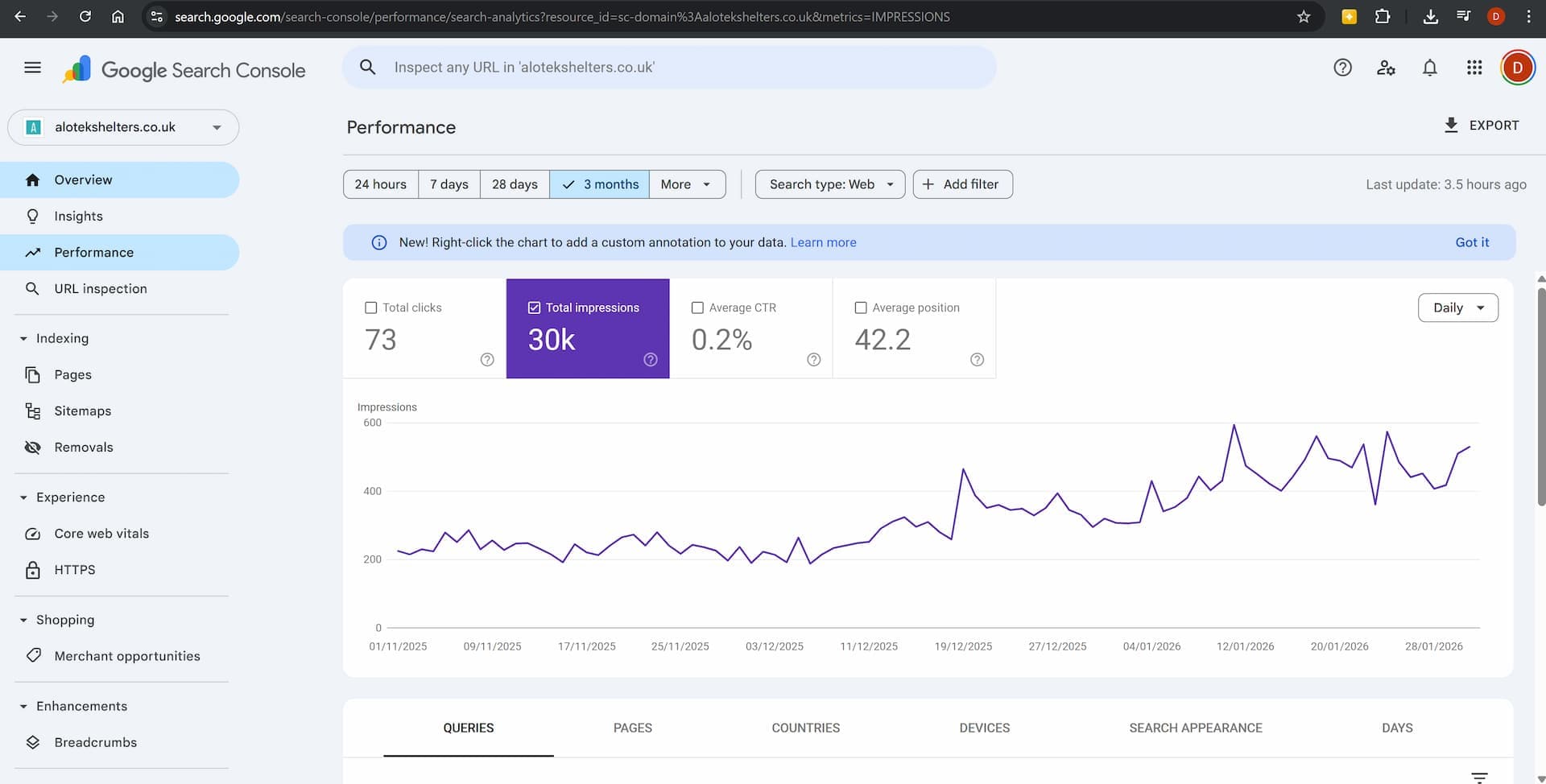
I publish the Sefton Coast Network, SouthportGuide.co.uk, FormbyGuide.co.uk, SeftonLinks.com, and SeftonCoastWildlife.co.uk, as a proof-of-concept for structured content publishing at scale. This is the Q1 2026 honest account: what's growing, what's flat, and what the data shows about how topical authority actually develops.
All data is from Plausible Analytics. These are honest numbers with no manipulation.
SouthportGuide.co.uk: the anchor site
SouthportGuide is the oldest and largest site in the network. It has the most pages, the most structured data, the most content depth. Q1 2026 organic traffic is up on Q1 2025 across every category except direct, which is an artifact of seasonality rather than a structural issue.
The strongest performing pages in Q1 were: the parking guide (consistently high intent, direct commercial value to visitors), the hotels category page (accommodation searches are building ahead of The Open), and the new area guides, Living in Churchtown, Living in Birkdale, Living in Ainsdale, which are ranking for long-tail residential property searches we weren't previously targeting.
What's flat or underperforming: the individual business pages rank well for brand name searches but are not consistently generating category-level traffic. The pSEO approach here requires more citation from editorial content to build relevance at the category level. This is the next piece of structural work.
SeftonLinks.com: the golf vertical
SeftonLinks has a very specific audience and a very specific traffic opportunity: The Open Championship 2026 at Royal Birkdale. The site is multilingual (20 languages), with full course guides for all six Sefton Coast championship courses, and a growing blog focused on course reviews and practical golf content.
The international traffic from non-English language versions started building in Q1. German, French, and American English are the strongest non-GB markets so far. This is consistent with the golf audience demographics for major championships, international visitors who search in their native language before they get to the UK.
The Open countdown content and accommodation guides are generating organic traffic three months before the event. This validates the pre-event content strategy: publishing relevant, well-structured content early enough to rank before search demand peaks.
Sefton Coast Wildlife: the slowest to build and the most interesting
SeftonCoastWildlife.co.uk is a 257-species database with editorial blog content. It's the site I'm most interested in from an SEO standpoint because it represents a genuine topical authority play: a site that covers a specific topic (wildlife on a specific stretch of coast) more comprehensively than anything else online.
Organic growth has been the slowest of the four sites because the audience is smaller and the search volume for specific species and wildlife watching content is lower than for "Southport hotels" or "Formby beach." But the traffic quality is high, low bounce rates, long session durations, high return visitor rates, which are the signals of content that's actually useful rather than just ranking.
The species spotlight content is starting to rank for specific species name searches. "Short-eared owl Southport," "Natterjack toad Sefton Coast," "Sand lizard Ainsdale", these are low-volume but high-intent queries that are now sending consistent traffic. The pattern suggests that as the database grows, the cumulative long-tail traffic will be significant.
FormbyGuide.co.uk: the development site
FormbyGuide is the newest and smallest site. Q1 2026 was a build phase: new content, improved structure, and the launch of the blog. The red squirrel content was always going to be the high-traffic entry point, "red squirrels Formby" has consistent search volume from visitors planning National Trust visits.
The day trip guide (Formby as a day trip from Liverpool) is the strongest organic performer in terms of pure traffic, the audience is large, the content is directly useful, and it's ranking page one for "Formby day trip" queries. This is the template for how FormbyGuide builds: high-intent visitor content that answers real questions from people planning a specific trip.
Network effects: what actually cross-links produce
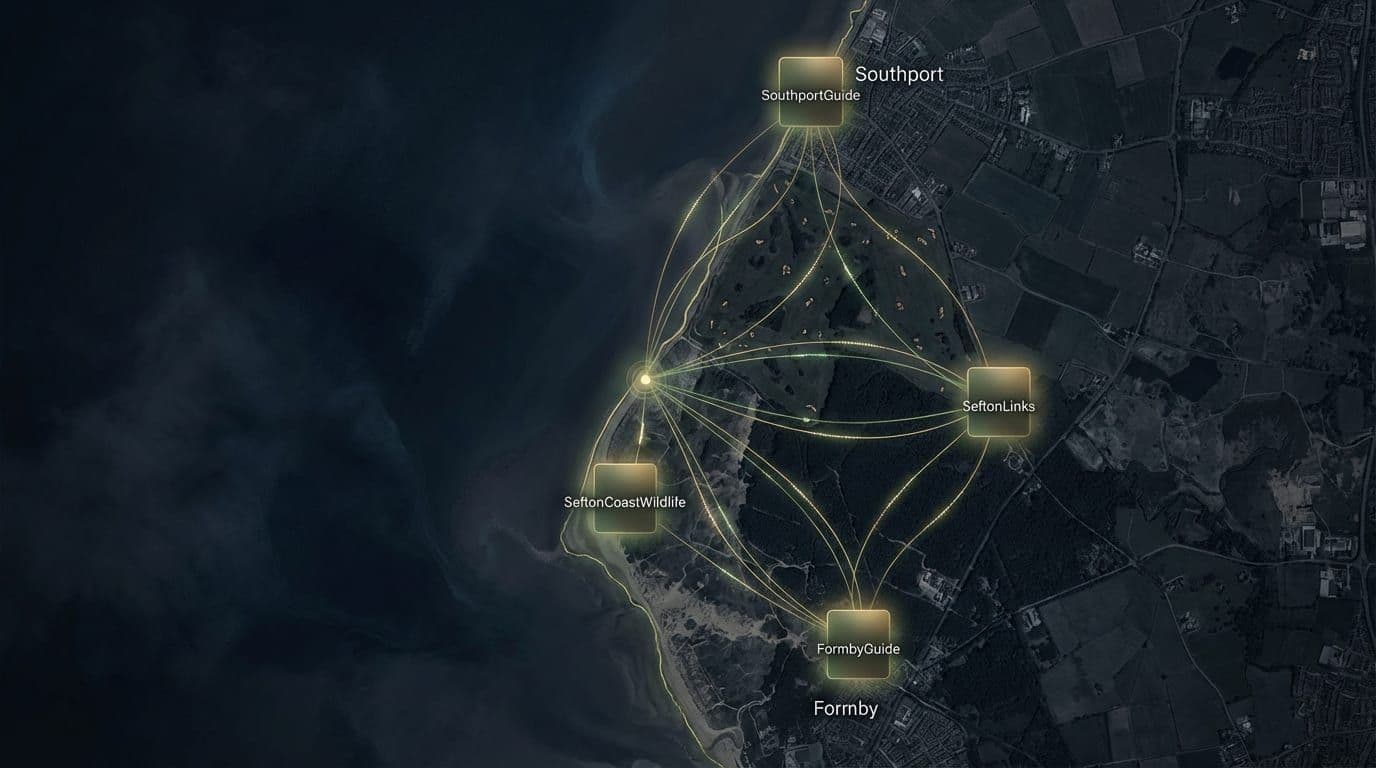
The network cross-links (footer links between all four sites with full PageRank flow) have had a measurable effect on domain authority metrics across all properties. Whether this translates directly into ranking improvements is harder to isolate, but the pattern is consistent with the theory: a group of thematically related, high-quality sites linking to each other with contextual relevance is a different signal from generic link building.
The more interesting cross-link effects are editorial: when SouthportGuide links to SeftonLinks for golf content, or when SeftonCoastWildlife links to SouthportGuide for beachcombing guides, the links make sense to a human reader. That's the test.
What Q2 2026 looks like
Three months to The Open. The primary focus for SouthportGuide and SeftonLinks is accommodation and transport content, the searches that are live and growing right now. FormbyGuide gets its spring and summer content push (the beach season starts properly in May). SeftonCoastWildlife publishes the orchid and summer wildlife content.
The network is a three-year build. Q1 2026 is the end of Year 1. The data so far is consistent with the thesis: structured, high-quality topical content, properly interlinked, builds sustainable organic traffic that compounds over time. The alternative, paid search with no organic foundation, looks expensive from where I'm standing.
If you want to build something similar for your market, a topical authority site or network in your vertical, get in touch. The methodology is transferable to any local market with underserved content.
Related: Why We Built the Sefton Coast Network · Eating Our Own Dog Food, How the Network Demonstrates What We Sell
Written by Damian Roche
Founder & CEO, Churchtown Media
20+ years building websites, 15+ years obsessing over SEO. Based in Southport, helping North West businesses turn traffic into revenue with Next.js and data-driven strategies.
More about DamianNeed Help With This Strategy?
We implement these exact strategies for North West businesses. Get a free audit and see where you stand.
Get Your Free AuditRelated Reading
Need help implementing this?
We help Southport businesses turn these strategies into revenue.
Book Strategy Call