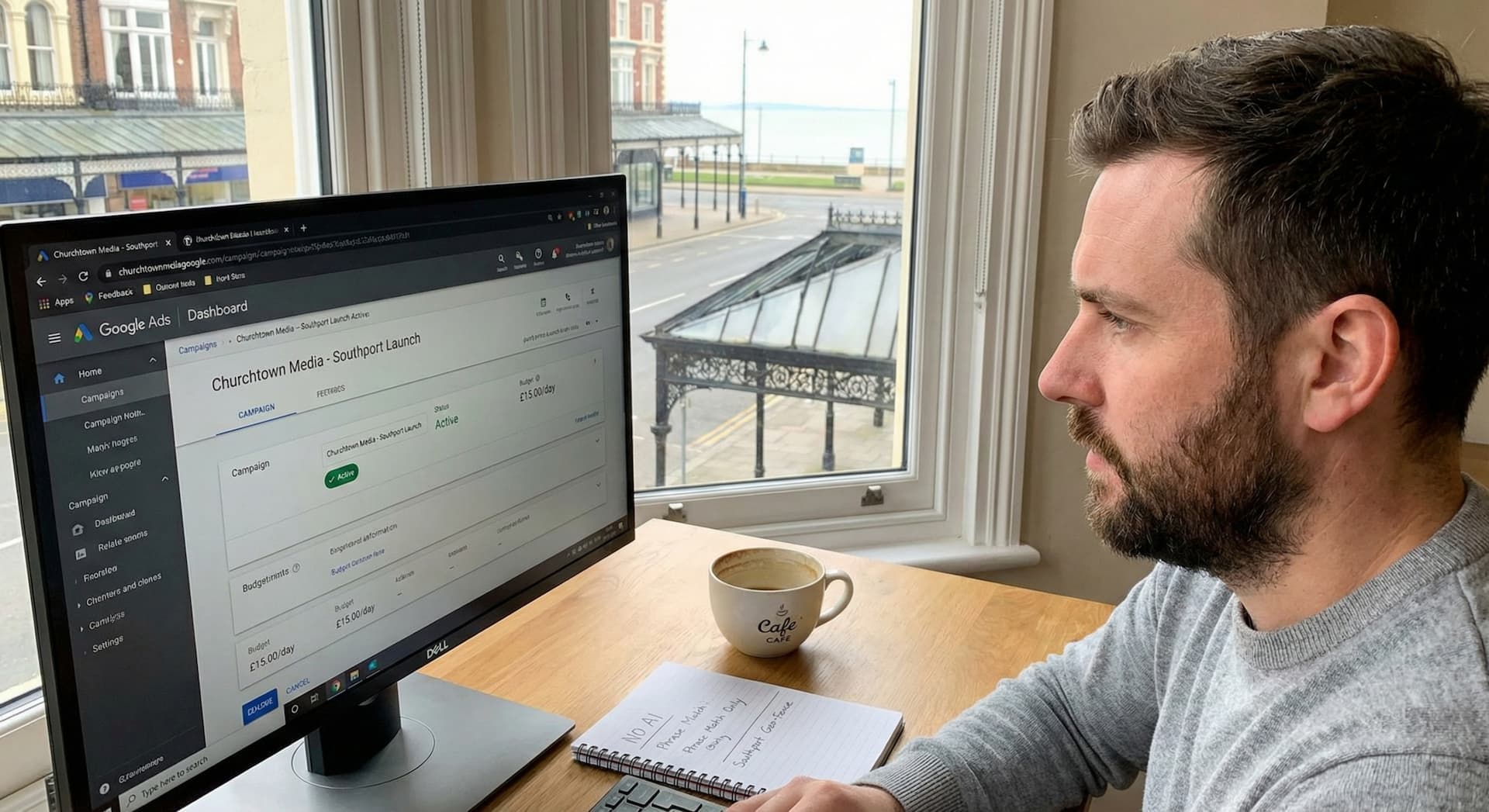
It's a strange feeling for a digital marketer to press "Publish" on their own ad campaign.
I spend my days managing budgets for clients, obsessing over their ROI and technical SEO. I know this stuff works. But when it's your own debit card attached to the account, the stakes feel different. It becomes personal.
Welcome to the "Radical Transparency" section of our blog. This is where we pull back the curtain on agency life in Southport. No shiny case studies, just the real-time grinding of growing a business.
Today, I'm sharing the exact setup of the very first Google Ads campaign for Churchtown Media.
Why? Because most local businesses get ripped off by Google Ads, and I want to show you exactly how we set ours up to avoid the common traps.
This is the "Default" Trap
If you are a local business owner--say, a plumber in Birkdale or a solicitor in town--and you try to set up Google Ads yourself, Google makes it incredibly easy. Too easy. For comprehensive support with your digital marketing strategy, check out our local business growth resources.
They push you toward "Smart Campaigns" and automated settings. They encourage you to use broad keywords and let their AI handle the rest.
If you follow their default advice, here is what usually happens: You spend £500 in a month. You get 200 clicks. 150 of them are from people outside the UK, 40 are students looking for "free tips," and maybe 10 are actual prospects.
You burn through cash, get zero leads, and decide "Google Ads doesn't work."
It does work, but only if you put a leash on it.
Our Blueprint: The "Anti-Volume" Strategy
For our campaign, we did the opposite of what Google recommends for new accounts. We don't want volume; we want value. We don't want 1,000 clicks; we want 5 phone calls from serious business owners in Southport.
Here are the three constraints we put on our own campaign:
1. Hyper-Local Geography (The Southport Fence)
Google will encourage you to target "Merseyside" or the "North West" to get more views.
We said no. Our ads only trigger if someone is physically standing in Southport, Formby, or Ormskirk, or if they specifically type "Southport" into their search.
If someone in Manchester searches for "best SEO agency," they won't see us. We don't want to pay for that click right now. We are building a local fortress first.
2. The "Kill List" (Negative Keywords)
The secret to a profitable campaign isn't just what you target; it's what you block.
Before we went live, we loaded up a list of "negative keywords." These are words that tell Google not to show our ad.
Our kill list includes words like: "cheap," "affordable," "free," "jobs," "course," and "DIY."
If someone searches for "Cheap web design Southport," we do not want to appear. We aren't competing in the race to the bottom. We want clients who understand that a fast, technical website is an investment, not a cost.
3. Ignoring the AI "Help"
During setup, Google kept flashing warnings: "Your audience is too small!" "Add these broad keywords to get more clicks!" "Switch to AI-powered ads!"
We ignored every single one.
We are using "Phrase Match" keywords. This means if we target "Web Design Southport", someone has to type that exact phrase (or a very close variation) to see us. We won't show up for loosely related terms like "graphic design."
This makes Google's algorithm nervous because it can't spend our money as fast as it wants to. But it makes us sleep better.
The Numbers: £15 a Day
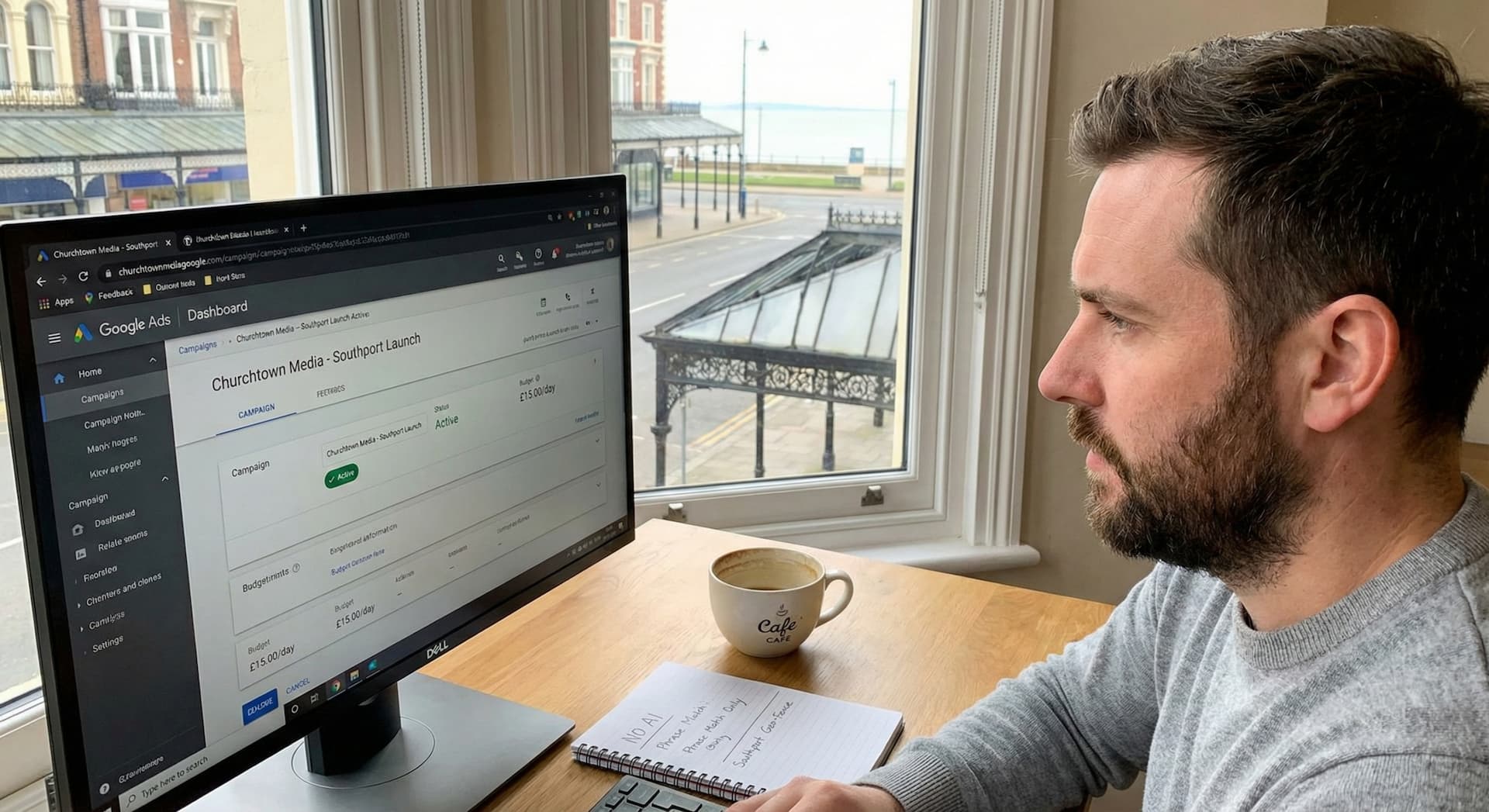
We set our initial budget to exactly £15.00 per day.
Why? In the Southport market for our niche, a good click costs between £3 and £5. This budget guarantees us about 3 to 5 highly qualified visitors to our site every single day.
That is enough data to know if our message is resonating, but not so much that we burn money while testing.
What Happens Next?
Right now, the campaign status is "Learning."
Over the next 7 days, Google will test our ads at different times of day. We might spend £2 one day and £18 the next. It will be volatile.
The hardest part is doing nothing. The temptation to tinker with bids or change headlines on Day 2 is immense. But you have to let the data accumulate.
In two weeks, I'll write a follow-up post right here. I'll share the actual results--how much we spent, what the Cost Per Click was, and most importantly, did anyone actually call us?
Win or lose, we'll post the numbers.
If you're a local business owner worried that your current agency or your own Google Ads efforts are leaking money on bad clicks, we do offer a free audit of your setup. We apply the same level of scrutiny to your account that we do to our own. Get in touch if you want a second pair of eyes.

Written by Damian Roche
Founder & CEO, Churchtown Media
20+ years building websites, 15+ years obsessing over SEO. Based in Southport, helping North West businesses turn traffic into revenue with Next.js and data-driven strategies.
More about DamianNeed Help With This Strategy?
We implement these exact strategies for North West businesses. Get a free audit and see where you stand.
Get Your Free AuditNeed help implementing this?
We help Southport businesses turn these strategies into revenue.
Book Strategy Call